Payload optics with no second chances.
There is no service call in orbit. We design RC and TMA telescope payloads with the stray-light control, tolerance margins and manufacturability evidence that survive launch — and the review board before it.
Space optics fail on the ground first
Most payload programs don't die from bad nominal designs — they die from designs that can't be fabricated at target cost, can't be aligned with available GSE, or lose contrast to stray light nobody modeled. The kill shots are boring: a tolerance budget that assumed heroic glass shops, a baffle designed after CDR, a detector that never matched the optics.
- Envelope-constrained design — apertures and focal lengths packaged into real fairings and buses
- Stray light engineered pre-hardware — baffles, vanes and coatings validated in simulation
- Launch-grade tolerancing — Monte-Carlo budgets with compensator and alignment strategy
- Detector-matched optics — sampling, SNR and MTF budgets that close at the pixel
Space programs we've delivered
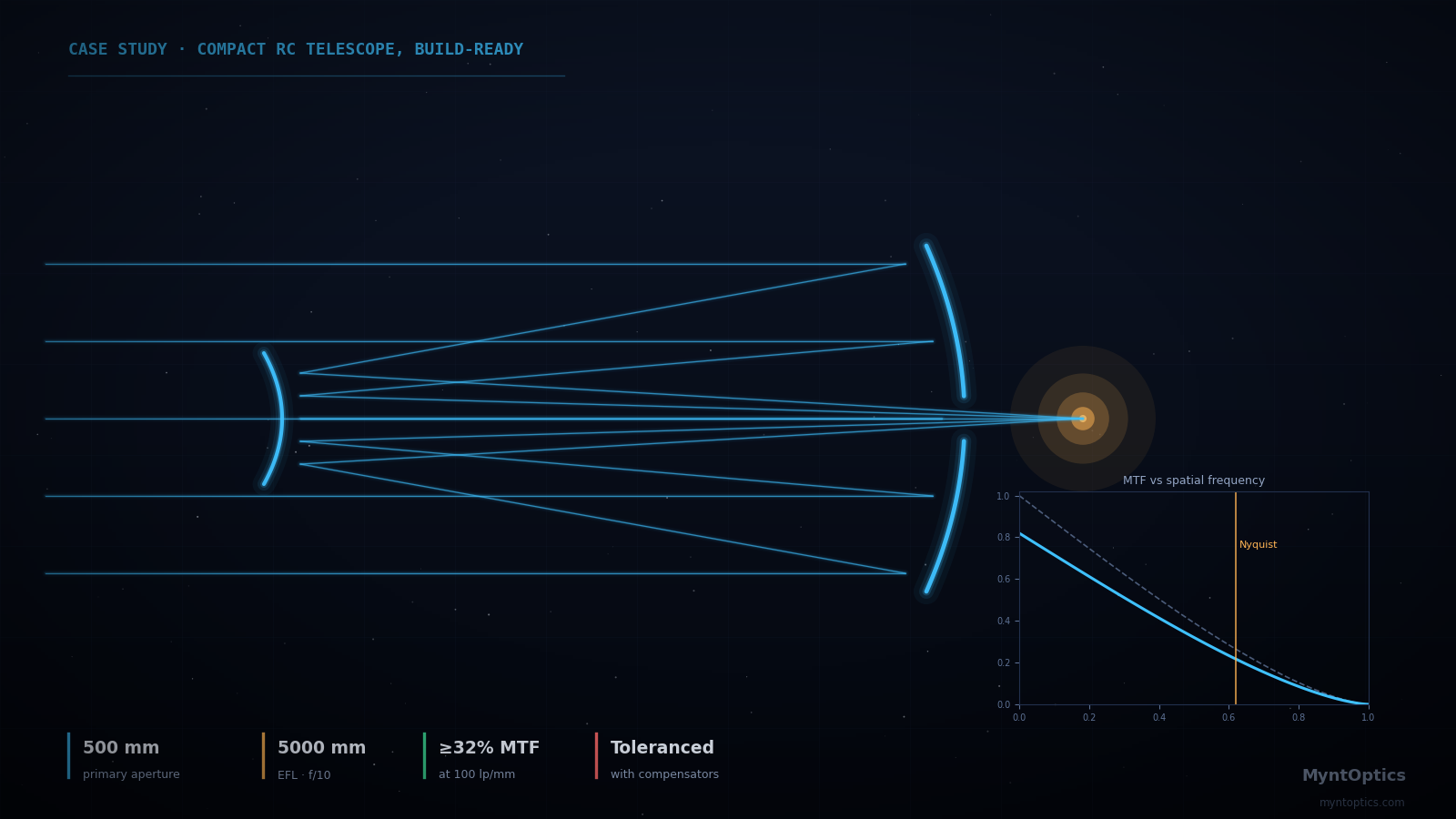
Compact 500 mm / 5000 mm EFL RC telescope
Full imaging payload design into a constrained envelope, with MTF, tolerance and compensator evidence.
Read →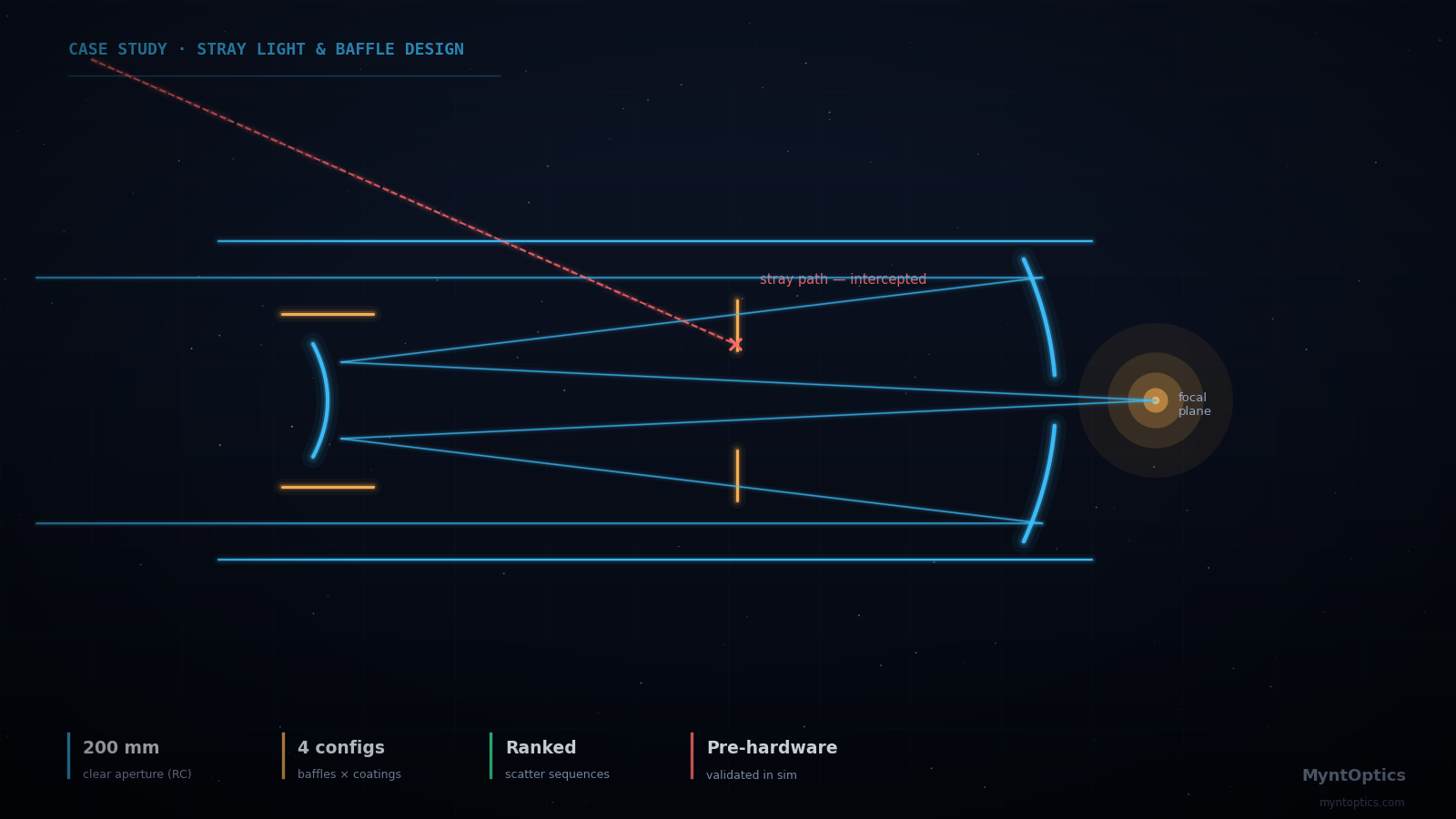
Stray light & baffle design, 200 mm RC
Four coating/baffle configurations quantified; dominant scatter paths ranked and suppressed before hardware.
Read →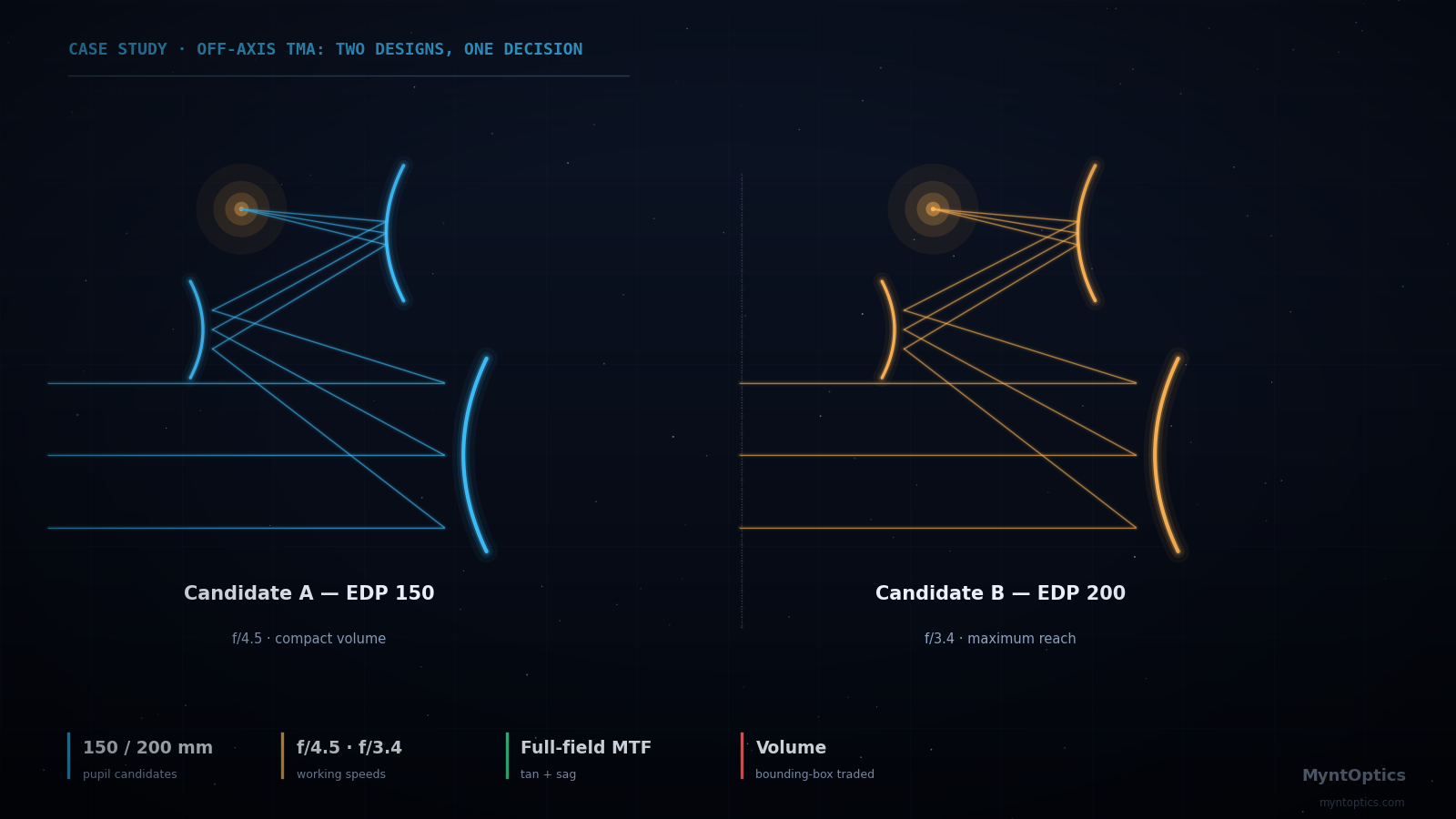
Off-axis TMA two-design feasibility
150 mm f/4.5 vs 200 mm f/3.4 unobscured TMAs traded on image quality and package volume.
Read →Space optics questions
Can you design to fit our existing bus and envelope?
Yes — envelope-constrained payload design is our specialty. The compact RC case study packaged 5000 mm of focal length into a tightly constrained volume with full tolerance evidence.
When should stray light analysis happen?
Before CDR — ideally alongside the optical design. Retrofitting baffles after first light is among the costliest mistakes in instrument development. We model the full opto-mechanical assembly with measured scatter data and validate suppression before metal is cut.
Obscured RC or off-axis TMA — which is right for us?
It depends on field, contrast requirements, volume and budget — which is why we run quantified trade studies rather than defaulting to a favorite. See the TMA feasibility study for how we structure the decision.
Building an imaging payload?
Start with a fixed-scope feasibility study: architecture trades, first-order performance, volume and risk — decision-ready before you commit the program.