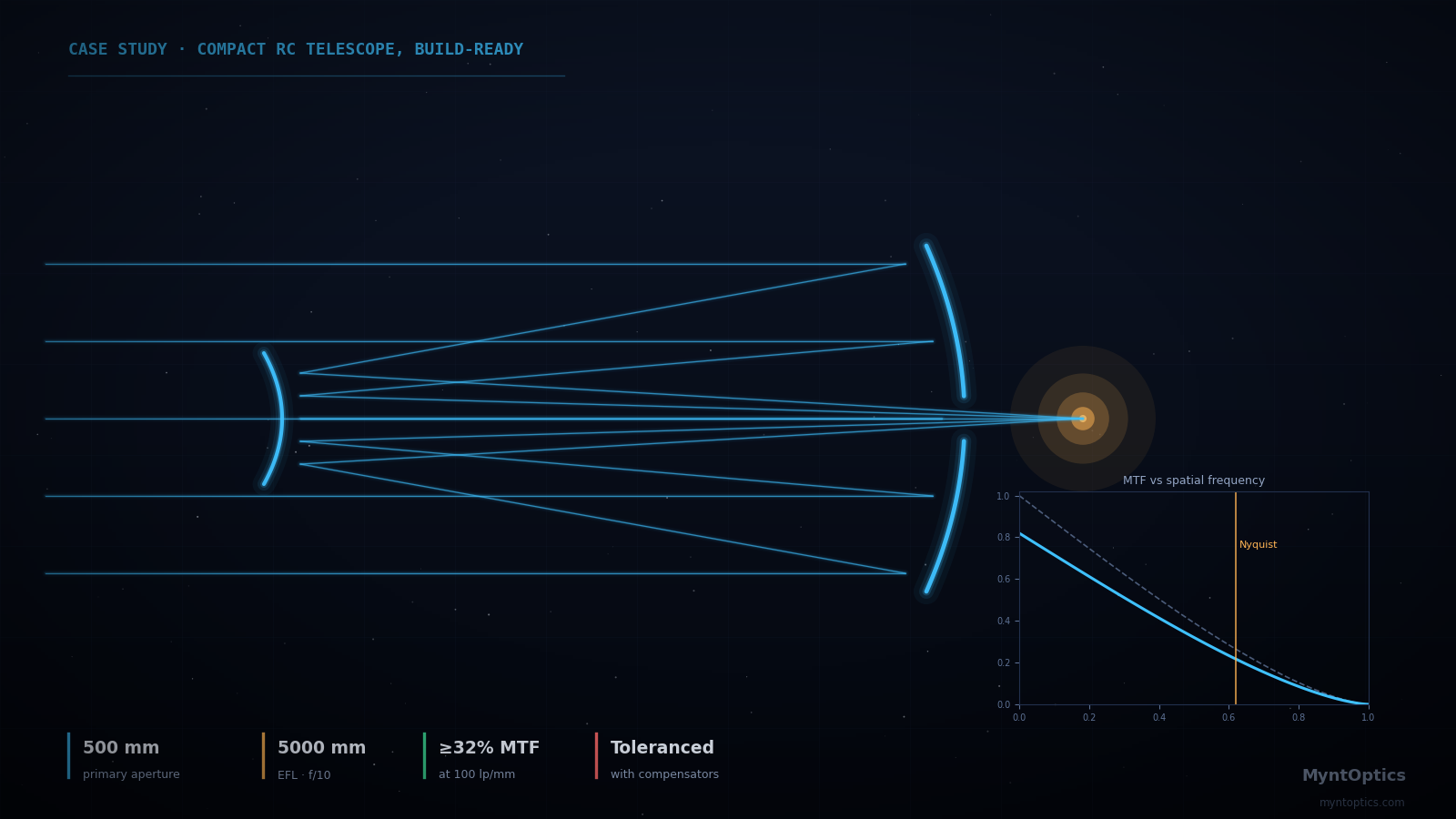
A 5000 mm effective focal length folded into a compact two-mirror package — with the system MTF evidence to prove it works as built.
Application
High-resolution imaging payloads — for Earth observation, astronomy and long-range identification — need long focal lengths in short packages. This program called for a reflective imaging telescope delivering a 5000 mm effective focal length from a 500 mm primary aperture, folded into a package envelope far tighter than a classical Cassegrain layout would allow, and matched to a small-pixel detector sampling at 100 lp/mm Nyquist.
The Challenge
At f/10 with 5 µm-class pixels, every design decision is contested by physics. The two-mirror Ritchey-Chrétien geometry removes spherical aberration and coma but leaves astigmatism and field curvature to be tamed; compressing the inter-mirror distance amplifies sensitivity to every tilt and despace in the assembly. The client did not just need a prescription that performed at nominal — they needed proof that the system would still meet specification as built, with realistic fabrication and alignment errors, across two operating wavebands.
What We Analyzed and Delivered
We developed a compact two-mirror RC geometry with a refractive field-corrector path, then subjected it to a full performance and manufacturability interrogation:
- Image quality across the field: MTF, spot performance, distortion, field curvature and wavelength-dependent focus behavior at 550 nm and 900 nm — including detector sampling effects, so the MTF budget reflects the system, not just the glass and mirrors.
- Tolerance analysis: sensitivity of every surface to decenter, tilt, despace and figure error, with a worst-offender ranking that tells the program exactly which parameters deserve tight tolerances and which can be relaxed to save cost.
- Compensator strategy: a defined adjustment scheme (focus and secondary-mirror positioning) that recovers performance after assembly, turning hard fabrication tolerances into manageable alignment procedures.
- Stray-light and baffle planning for the central-obscuration path, so contrast performance survives outside the lab.
Achieved Specifications
| Parameter | Achieved |
|---|---|
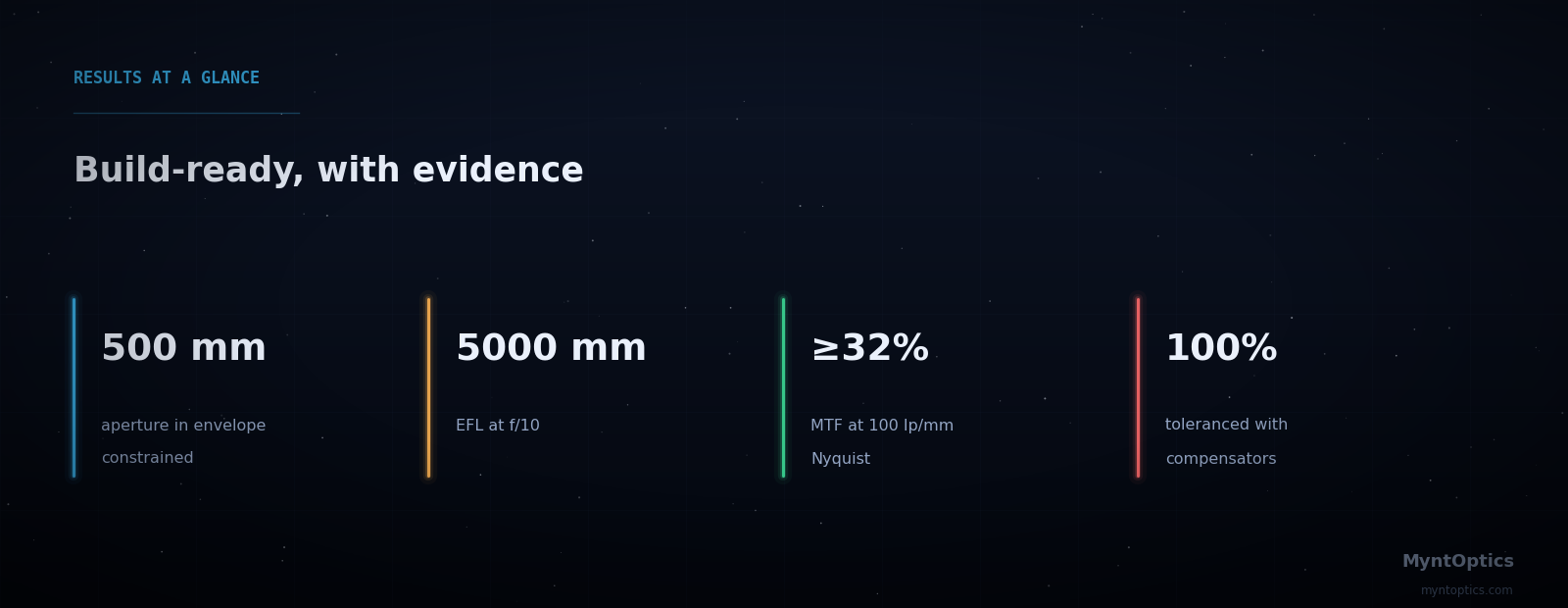
| Primary aperture | 500 mm |
| Effective focal length | 5000 mm (f/10) |
| Spectral coverage | 550 nm and 900 nm bands |
| Detector sampling target | 100 lp/mm (Nyquist) |
| System MTF at Nyquist | Meets ≥32% specification, including detector sinc roll-off |
| Tolerance evidence | Full sensitivity + worst-offender analysis at tolerance limits vs nominal |
| Alignment approach | Defined compensator strategy validated in simulation |
Why This Matters
A lens prescription is not a product. The distance between "performs in the design file" and "performs on the bench" is covered by tolerance analysis, compensator strategy and stray-light planning — the unglamorous evidence that determines whether a payload program hits its schedule. MyntOptics delivers designs with that evidence attached: when our design package leaves, it carries the MTF budget, the tolerance table, the alignment plan and the baffle concept that make it manufacturable the first time.
Planning a high-resolution imaging payload? Start a conversation — we can take you from requirements to a build-ready optical design package.
Have a similar engineering challenge? Talk to our optical engineers — a fixed-scope diagnostic turns uncertainty into a costed plan, typically within weeks.