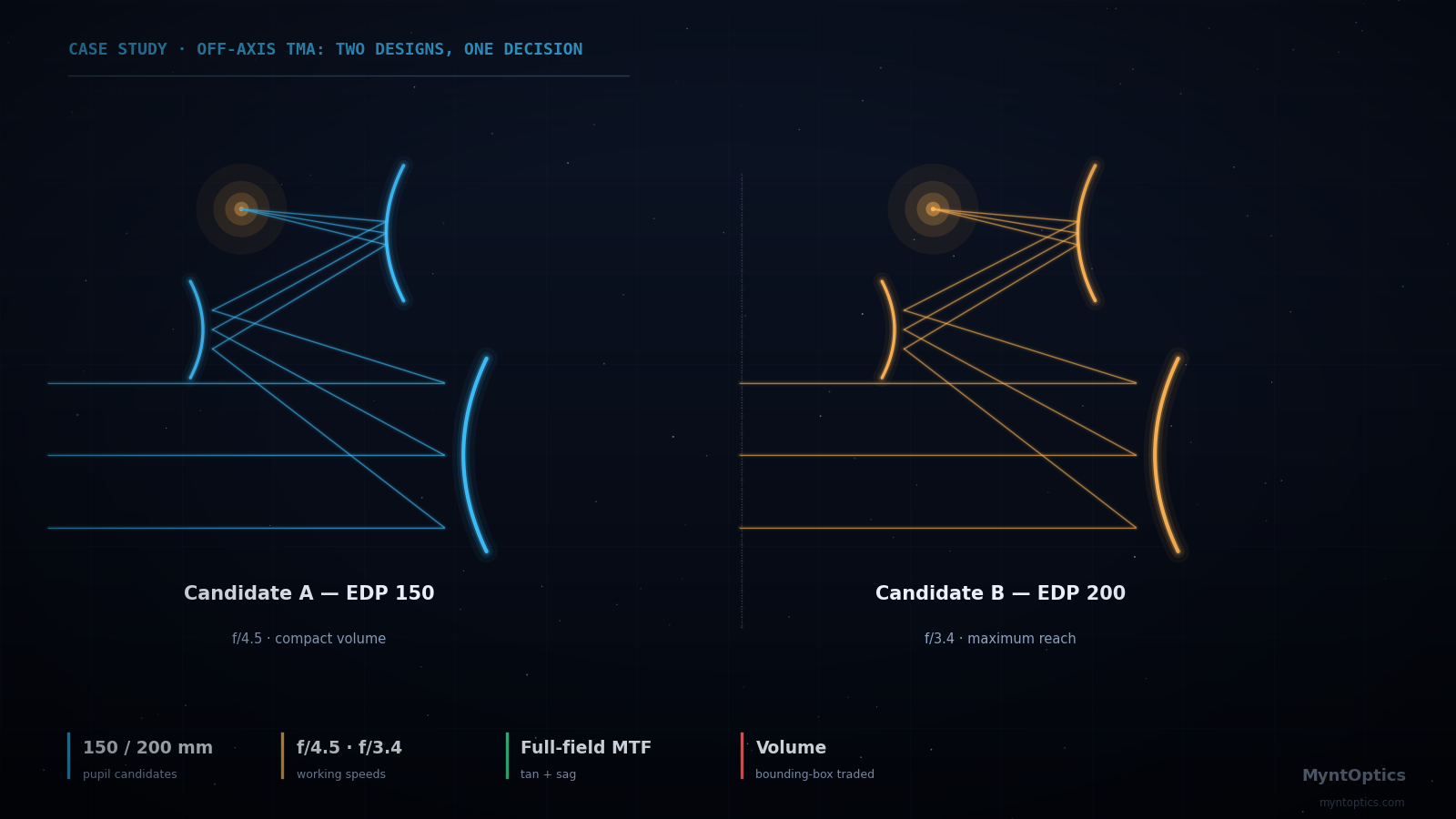
Both unobscured TMA candidates carried to comparable maturity — so the aperture-class decision rests on symmetric evidence, not on whichever design got more attention.
Application
The three-mirror anastigmat (TMA) is the architecture of choice for modern Earth-observation payloads: an unobscured, all-reflective form that corrects spherical aberration, coma and astigmatism simultaneously, works over any waveband, and delivers wide, well-corrected fields that two-mirror systems cannot. But "a TMA" is not a decision — aperture, speed and packaging interact in ways that lock in payload mass, volume and resolution for the life of the program. This engagement was a structured two-design feasibility study to put that decision on solid ground.
The Challenge
The client needed to choose between two entrance-pupil classes before committing detailed design resources:
- Candidate A — 150 mm entrance pupil, f/4.5
- Candidate B — 200 mm entrance pupil, f/3.4
A bigger, faster aperture buys resolution and radiometric margin, but the cost is paid in mirror size, alignment sensitivity and payload envelope. The wrong call discovered six months into detailed design is a program-level setback. The right call requires both candidates to be developed far enough that the comparison is honest — equal optimization effort, equal evidence.
What We Analyzed
We carried both unobscured off-axis TMA layouts to comparable maturity and evaluated them head-to-head:
- Image quality: full-field FFT MTF for each candidate — tangential and sagittal — assessed against their respective diffraction cutoffs (403 lp/mm for the f/4.5 design, 540 lp/mm for the f/3.4 design), plus geometric spot analysis across the field grid.
- Aberration behavior: residual field-dependent aberrations mapped across the format, identifying where each design holds correction and where it degrades.
- Package volume: physical optical bounding boxes for both candidates, compared in side and top projections — the numbers a structures team can actually work with.
- Risk framing: mirror footprints, freeform/asphere demands, and the path to package closure and full-field aberration control for the preferred candidate.
Achieved Results
| Evidence Delivered | Candidate A | Candidate B |
|---|---|---|
| Entrance pupil | 150 mm | 200 mm |
| Working speed | f/4.5 | f/3.4 |
| Diffraction cutoff | 403 lp/mm | 540 lp/mm |
| Layout + MTF + spot evidence | Complete | Complete |
| Optical bounding-box envelope | Quantified | Quantified |
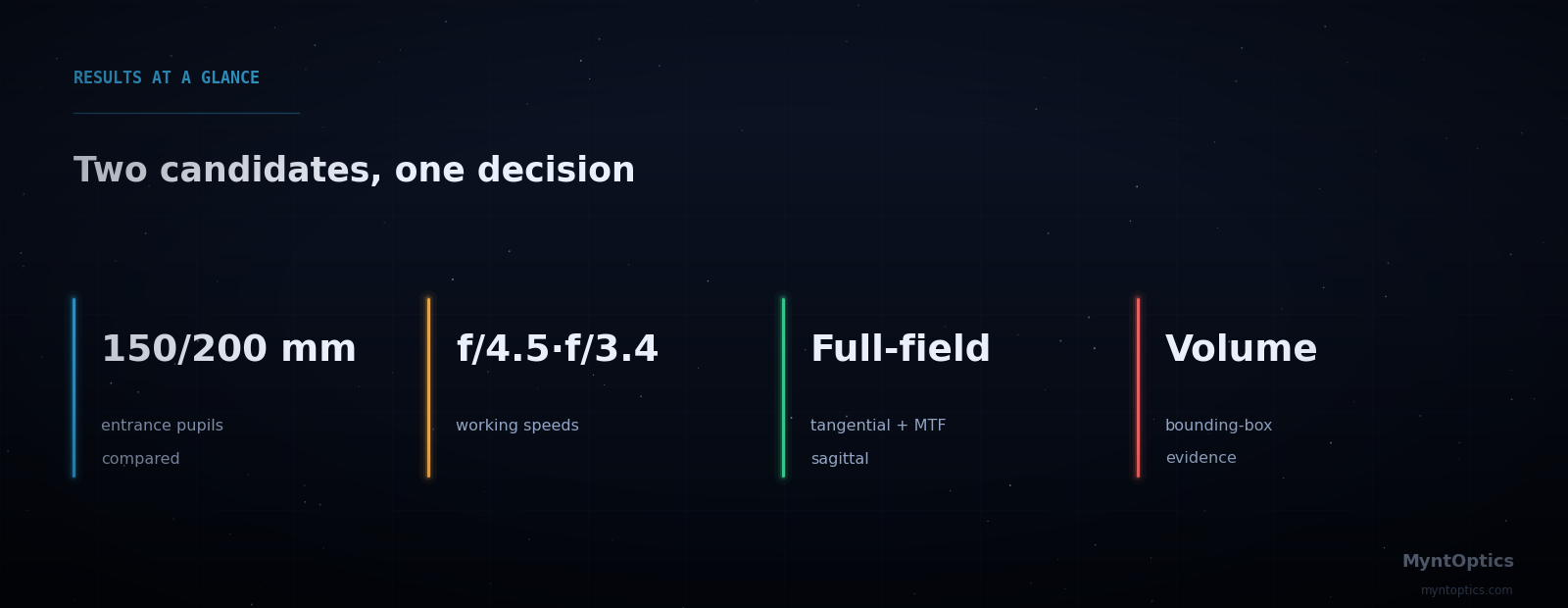
The two-design report gave the client a like-for-like trade between resolution potential and payload envelope, with the follow-on work — package closure, mirror footprint refinement, full-field aberration control — already scoped for the selected path.
Why This Matters
Feasibility studies are where payload programs are quietly won or lost. Committing to an architecture on intuition, or on a single design point developed in isolation, embeds risk that surfaces at the worst possible time. MyntOptics runs disciplined multi-candidate studies with symmetric effort and transparent evidence — layouts, MTF, spots, volumes — so engineering leadership can make aperture-class decisions they can defend in review.
Weighing optical architectures for your next payload? Engage our team for a feasibility study that turns opinion into evidence.
Have a similar engineering challenge? Talk to our optical engineers — a fixed-scope diagnostic turns uncertainty into a costed plan, typically within weeks.