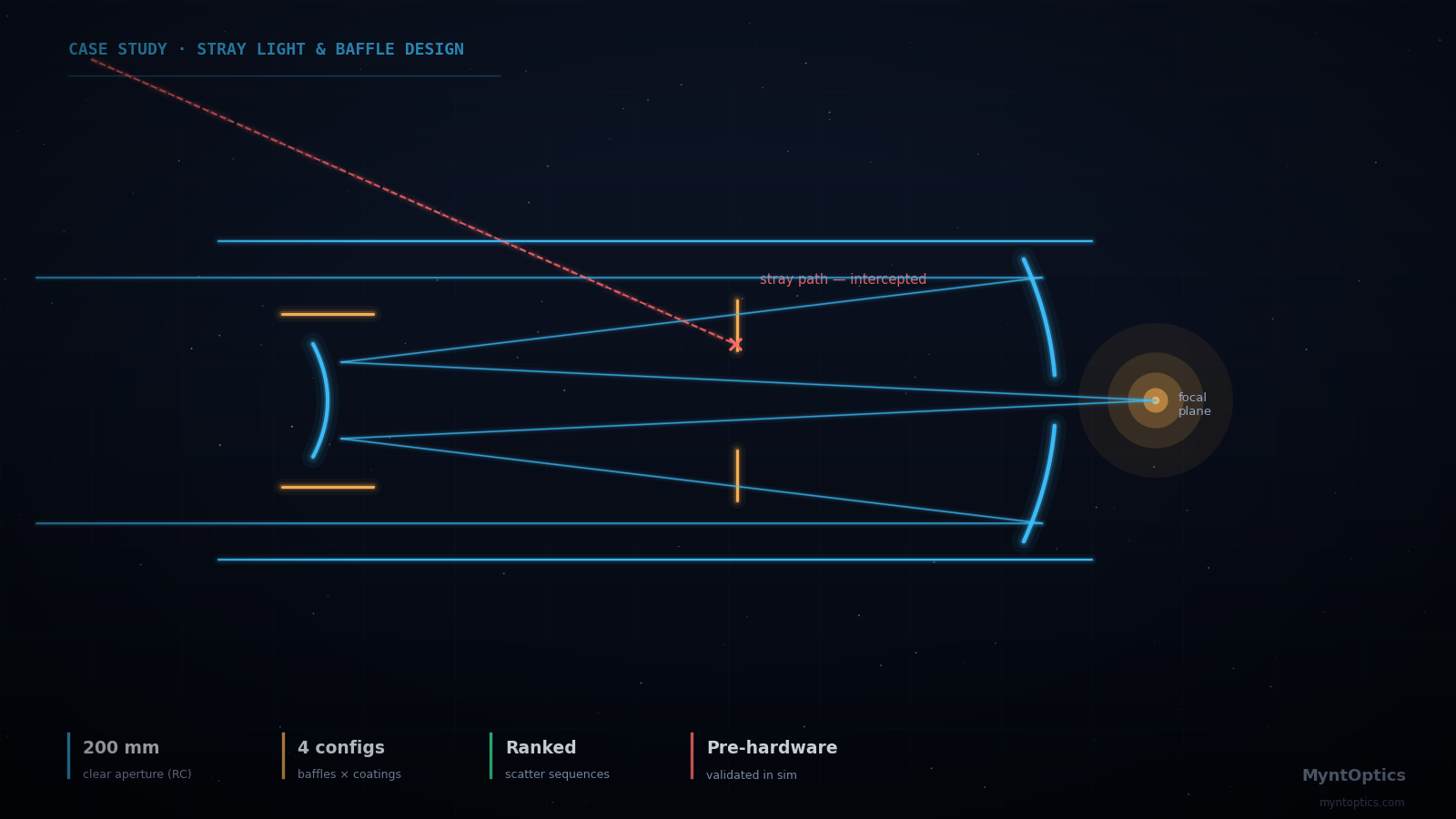
Primary and secondary baffles intercept the off-axis sneak paths that conventional image-quality analysis never sees.
Application
Two-mirror reflective telescopes — the workhorses of astronomy, Earth observation and space situational awareness — live or die by contrast. A design can be diffraction-limited on paper and still be unusable in the field, because light from outside the field of view finds its way to the detector: skyglow, the Moon just outside the frame, sunlight grazing the barrel interior. This case study covers a stray light evaluation and suppression program we executed for a 200 mm clear-aperture Ritchey-Chrétien imaging telescope.
The Challenge
Stray light is invisible in conventional sequential ray tracing. Image-quality metrics such as MTF and spot size say nothing about the photons that never belonged in the image in the first place. The engineering questions were concrete:
- How much out-of-field energy actually reaches the focal plane in the as-drawn opto-mechanical assembly?
- Which mechanical surfaces are responsible — and through which scatter paths?
- How much suppression do dedicated primary and secondary baffles deliver, and is an exotic ultra-black coating worth its cost and handling constraints compared to a conventional matte black treatment?
Answering these questions after the prototype is built is expensive. Answering them before metal is cut is an analysis problem — and that is where we came in.
What We Analyzed
Working from the full opto-mechanical CAD of the telescope — mirrors, barrel, spider, retainers, covers — we built a physics-based scattered-light model of the complete assembly and evaluated focal-plane irradiance under off-axis illumination across four build configurations:
- Bare assembly, conventional matte black interior, no baffles
- Bare assembly, ultra-black high-absorptance coating, no baffles
- Baffled assembly (primary cone + secondary shroud), conventional matte black
- Baffled assembly, ultra-black coating
For each configuration we traced the dominant stray-light sequences — the specific bounce paths that deliver unwanted energy to the detector — and ranked the contributing mechanical surfaces. Measured bidirectional scatter characteristics for each candidate surface treatment were used, so the comparison reflects real coating behavior rather than idealized absorbers.
Outcome and Achieved Results
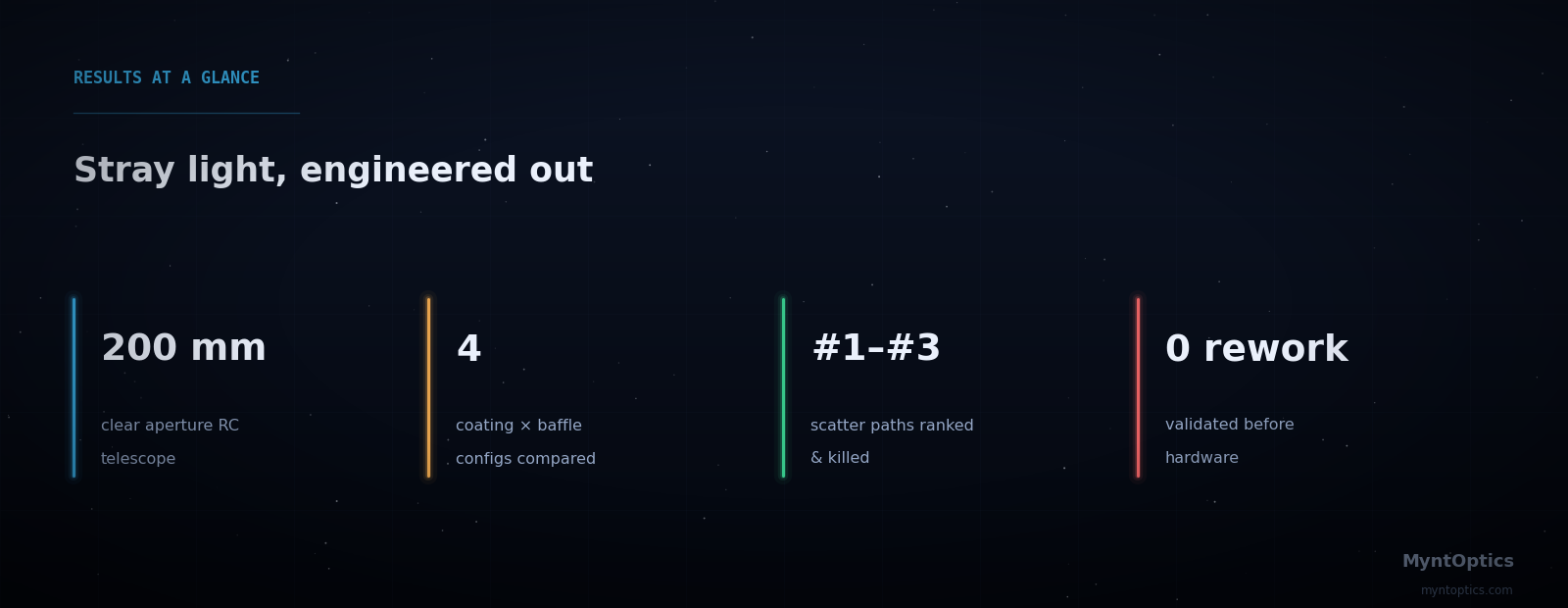
- Quantified focal-plane stray-light irradiance for all four coating/baffle configurations under identical off-axis source conditions, giving the client a like-for-like decision matrix instead of rules of thumb.
- Identified and ranked the dominant scatter paths, isolating the barrel interior and the region around the secondary as the principal first-bounce contributors in the unbaffled design.
- Validated a primary–secondary baffle geometry that blocks the direct sneak paths to the focal plane without vignetting the science field.
- Settled the coatings question with data: the analysis showed where a conventional matte black is sufficient once baffles are in place, and where the ultra-black coating genuinely pays for itself — allowing cost to be spent only where it changes performance.
- Delivered irradiance maps on the primary baffle, secondary baffle and barrel that now serve as the thermal and contamination-control reference for the program.
Why This Matters
Most optical design houses stop at image quality. Contrast-critical instruments — astronomical telescopes, star trackers, space-domain-awareness sensors, long-range surveillance imagers — fail or succeed on stray light control, and retrofitting baffles after first light is among the costliest mistakes in instrument development. MyntOptics treats scattered-light engineering as a first-class design activity: we model the entire opto-mechanical assembly, not just the lens prescription, and we hand over suppression strategies that are verified in simulation before fabrication.
Building an imaging system where contrast matters? Talk to our engineers about a stray light audit of your design — before the hardware tells you the hard way.
Have a similar engineering challenge? Talk to our optical engineers — a fixed-scope diagnostic turns uncertainty into a costed plan, typically within weeks.