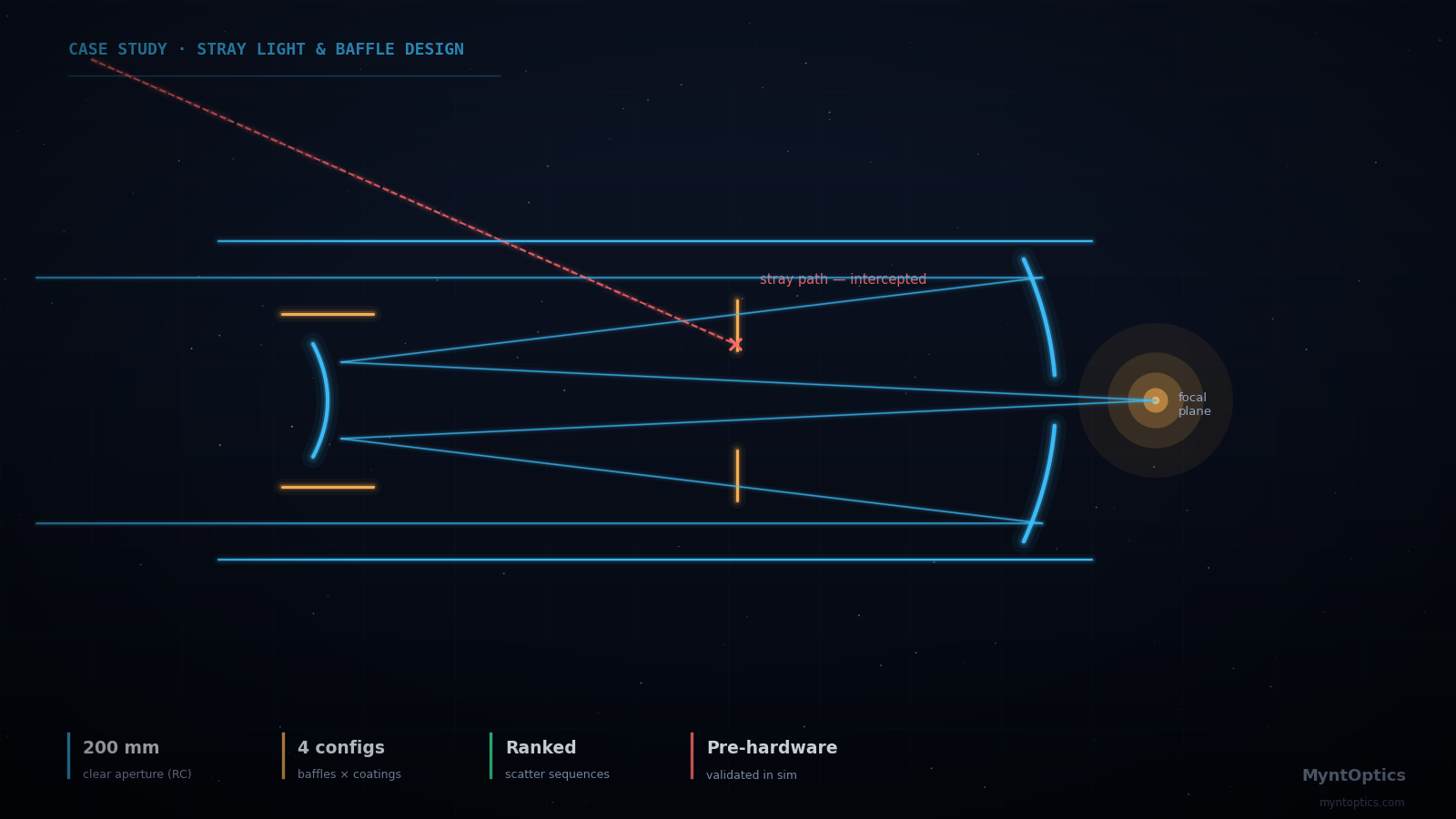
Every optical program budgets for aberrations: MTF curves, spot diagrams, wavefront error. Almost none budget for the photons that aren't supposed to be there. Then hardware arrives, the first field images show a milky haze, a phantom blob follows bright sources across the frame, and a "diffraction-limited" instrument delivers contrast a webcam would be ashamed of. Nothing in the design failed — except that the design was only ever half of the physics.
What stray light actually is
Stray light is every photon that reaches the detector by a path the designer didn't intend. It arrives three ways:
Ghost reflections. Every uncoated glass surface reflects ~4% of incident light; even good AR coatings reflect 0.2–0.5% per surface. Light that bounces off two surfaces and still reaches the detector forms ghosts — in-focus doppelgängers of bright sources, or defocused pupil images sitting in the middle of your scene. A ten-element lens has 45 two-surface ghost pairs; nobody's intuition tracks 45 paths.
Scatter. Real surfaces are not the mathematical planes of the model. Micro-roughness, dust, coating defects and machined mechanical surfaces all scatter light — quantified by BSDF measurements — turning every illuminated interior part into a dim, diffuse source aimed at your focal plane.
Sneak paths. Out-of-field light that reaches the detector without ever touching the optics: past an undersized baffle, through a reflective barrel thread, off a shiny retainer edge. These are geometry problems, invisible in a sequential ray-trace by construction.
Why it surfaces late — and costs so much there
Sequential design software traces the intended path only. Stray light lives in the non-sequential model: the full opto-mechanical assembly, with real coatings and measured scatter data, illuminated from every angle the mission will actually see. Programs skip it because the nominal design "looks done," and because the analysis requires exactly the mechanical detail that doesn't exist until late.
The economics are brutal in both directions. In simulation, a baffle change is an afternoon. After anodized metal exists, the same change is tooling, requalification and schedule. Retrofitting stray-light control is consistently among the most expensive fixes in instrument development — and among the cheapest analyses to run early.
The numbers that make it an engineering discipline
Stray light stops being folklore the moment it gets a requirement. The forms we use:
- Ghost irradiance ratio — brightest ghost as a fraction of its parent source's image irradiance. Metrology instruments may need 10⁻⁶; we've delivered analyses chasing paths to 10⁻¹⁴ for arc-second-class alignment optics, where a ghost near the reticle biases the measurement itself.
- Veiling glare index — detector signal from a bright extended surround when imaging a black target; this is the number that quietly caps contrast for surveillance, automotive and space cameras.
- Point-source transmittance (PST) — for telescopes: focal-plane irradiance versus off-axis angle of a bright source (sun, moon, Earth limb). The PST curve is the baffle specification.
- Solar/illuminator exclusion performance — the specific geometry cases (headlights at night, sun at 30° off-axis, the IR illuminator ring around the lens) that define your worst hour in service.
What a proper analysis delivers
A stray-light work package worth paying for contains, at minimum:
- A ranked path list — every significant ghost and scatter path, ordered by detector irradiance, each traceable to the surfaces that created it. Ranking is what turns anxiety into a to-do list.
- Suppression design — baffle and vane geometry, threading/blackening callouts, coating priorities and stop placement — validated by re-running the model, not asserted.
- A before/after budget — predicted ghost ratios, veiling glare or PST against the requirement, with margin stated.
- The trade record — what each suppression measure costs in mass, envelope and money, so the program can choose with open eyes.
On a recent telescope program, four coating/baffle configurations were quantified this way before any hardware existed; the dominant scatter paths were ranked and the winning configuration chosen on evidence. That is the whole point: the streetlight test, the sun-angle test, the laser-in-the-lab test — all passed on the computer, where failing is cheap.
When to run it
The pragmatic schedule: a first-pass ghost analysis the moment a candidate lens prescription exists (days, catches the paths that force glass changes); the full non-sequential model once preliminary mechanics exist, and always before CDR; a verification pass on the as-built model. If your instrument images bright sources, operates near the sun, works at night among headlights, or claims precision measurement — the question is not whether to budget stray light, but whether you'd rather buy the answer in simulation or in a recall.
Have a similar engineering challenge? Talk to our optical engineers — a fixed-scope diagnostic turns uncertainty into a costed plan, typically within weeks.