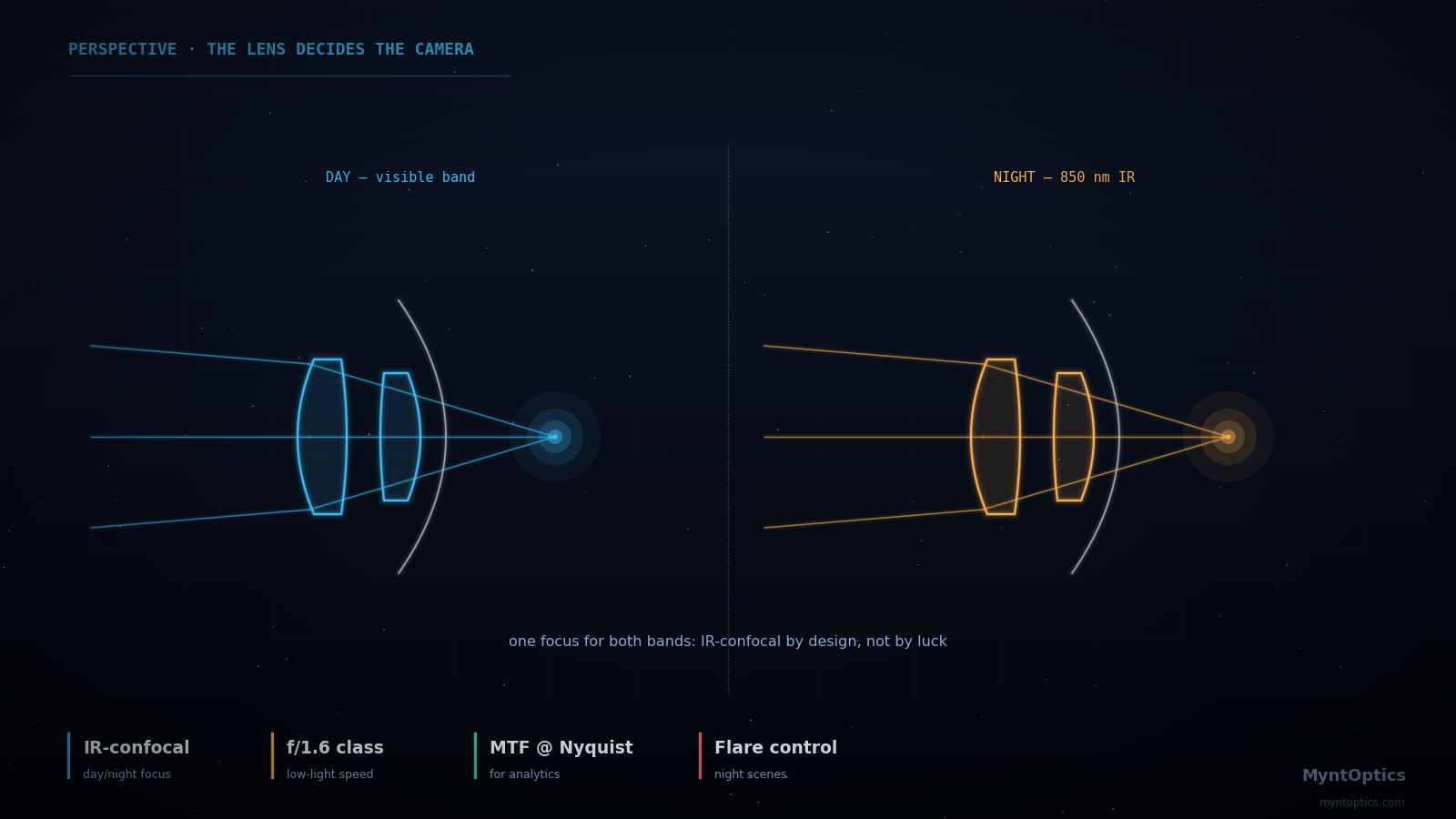
A surveillance camera looks like a solved problem: a small lens, a mass-market sensor, a housing. Then a fleet of them ships, night falls, temperatures swing, and the "8 MP" system delivers images no algorithm can identify a face from. The gap is almost always optical — and the engineering inside a good surveillance lens is far harder than its price tag suggests.
The specification that actually matters: MTF at the pixel
Resolution marketing counts pixels; recognition performance counts contrast delivered to those pixels. The governing number is MTF at the sensor's Nyquist frequency — for a 2.0 µm pixel, that is 250 lp/mm, a spatial frequency that would embarrass many laboratory lenses.
Two consequences follow:
- The pixel race has outrun cheap optics. A lens that resolved a 5 MP, 3.45 µm sensor competently delivers mush on an 8 MP, 1.55 µm one. Sensor upgrades without lens upgrades buy file size, not information.
- MTF must hold across the field and the aperture. Identification happens at image corners, at night, wide open. A lens specified only on-axis at f/5.6 is specified for the demo, not the deployment.
Day–night IR confocality: the silent killer
Most security cameras image visible light by day and 850/940 nm IR illumination by night. Ordinary lens designs focus these bands at measurably different depths — the chromatic focal shift between 550 nm and 850 nm in an uncorrected design can be several depths of focus. The camera that was sharp at noon is soft at midnight, and no motorized refocus fully rescues it across the zoom range.
Designing an IR-confocal lens means extending the achromatic correction across a 400–950 nm band — glass choices, power distribution and sometimes a diffractive or aspheric surface are all pulled by that single requirement. It is the defining discipline of the genre, and the first thing we check in any underperforming day/night system.
Fast apertures without fast excuses
Low-light performance pushes surveillance lenses toward f/1.4–f/1.8. Every halving of f-number doubles the light — and roughly quadruples the difficulty of aberration control. Spherical aberration and coma grow steeply with aperture; so does sensitivity to decenter and tilt, which matters when the lens is built in volume by the thousand. A credible fast lens design ships with a tolerance budget proving the production distribution of lenses meets MTF, not just the nominal prescription.
Flare, ghosts and the streetlight test
Night scenes are the adversarial case for stray light: a dark field punctuated by headlights, streetlights and IR illuminators. Ghost reflections between lens surfaces and off the sensor cover show up as phantom blobs that trigger motion analytics; veiling glare lifts the black level and erases shadow detail exactly where intruders stand.
Controlling it is design work, not tuning: coating strategy per surface, mechanical baffling, edge blackening, and a ghost analysis that traces two-bounce paths from every bright-source geometry the camera will actually face. We map these paths in simulation before tooling — the streetlight test should be passed on the bench, not discovered in the field.
Thermal drift and the physics of "set and forget"
A fixed-focus fleet camera must hold focus from −30 °C to +60 °C. Aluminum barrels expand, glass indices shift, plastics creep. Passive athermalization — choosing glass/housing combinations whose drifts cancel — is a first-order design constraint for outdoor optics, and one reason a competent surveillance lens is not simply a shrunken photography lens.
The checklist we use
When we design or audit a surveillance lens, the evidence pack answers:
- MTF at Nyquist, full field, wide open, both bands — with the production tolerance distribution, not just nominal.
- IR confocality — focal shift across 400–950 nm inside a fraction of the depth of focus.
- Ghost inventory — two-bounce paths from representative bright sources, ranked by irradiance at the sensor.
- Athermal budget — focus drift over the storage and operating range.
- Relative illumination and distortion — enough corner signal for analytics, and distortion the software stack actually corrects.
The takeaway
Surveillance optics is a genuine lens-design discipline wearing a commodity costume. If your fleet underperforms its sensor spec sheet, the lens is the first suspect — and the fix is engineering, not procurement. A one-week design audit that traces MTF, confocality, ghosts and thermal drift will usually name the culprit precisely, and tell you whether it is recoverable in firmware, in the next lens revision, or only in a redesign.
Have a similar engineering challenge? Talk to our optical engineers — a fixed-scope diagnostic turns uncertainty into a costed plan, typically within weeks.