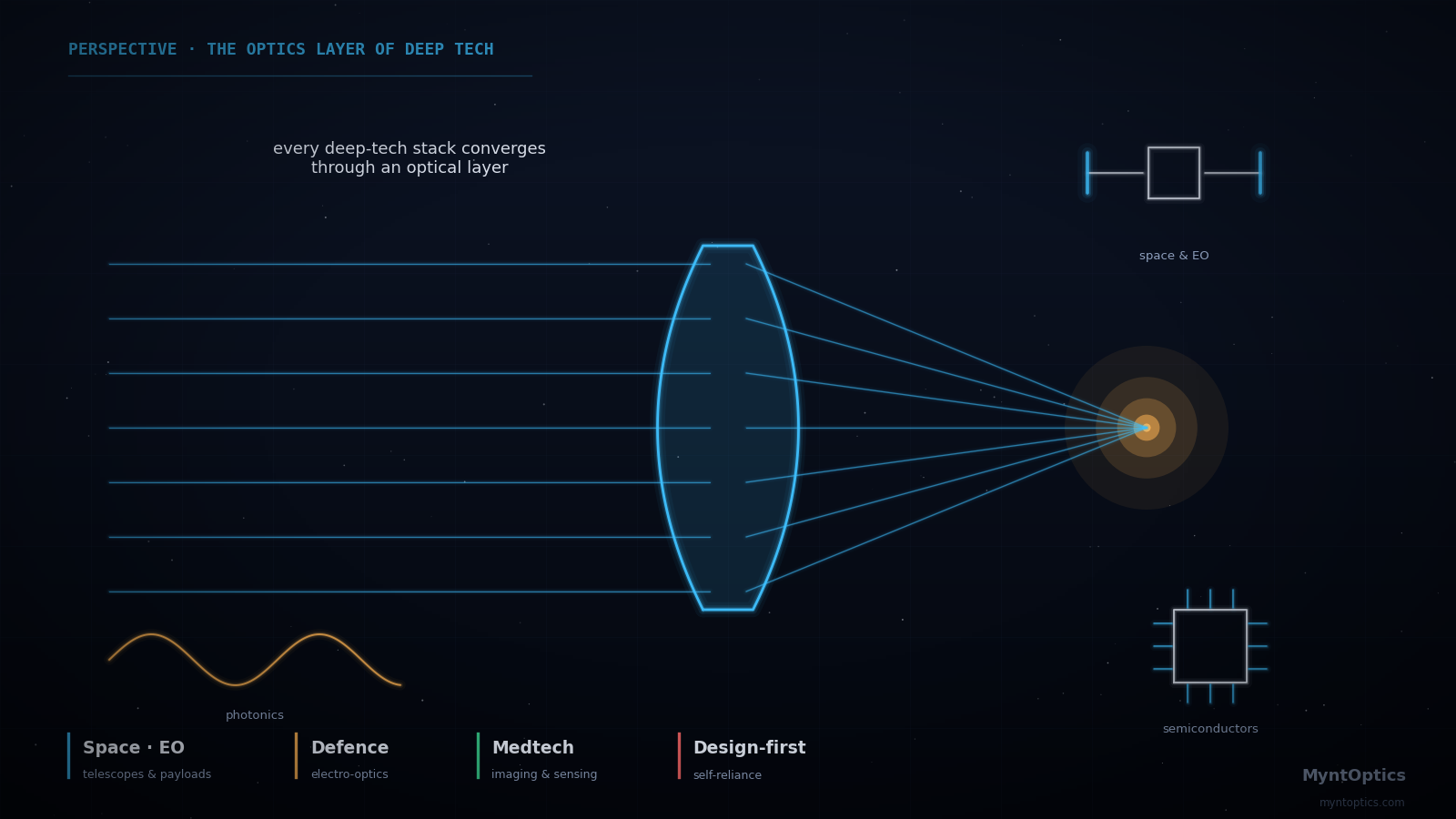
Nearly every deep-tech ambition — in space, defence, semiconductors, healthcare, autonomy and quantum — passes through a piece of precisely shaped glass. Yet in most hardware organizations, the optical layer is the one nobody owns: it is specified late, purchased blind, and debugged at integration. That gap deserves more attention than it gets, because the optical layer is quietly load-bearing for the entire product.
The sense organ of deep technology
Optics is where physics is converted into data. Look at any sector currently attracting deep-tech capital and you will find an optical system at exactly that conversion point.
Space. An Earth-observation satellite is, reduced to its essentials, a telescope with a spacecraft attached. Ground resolution, swath and radiometric quality are decided by mirror figure, alignment tolerances and stray-light control — long before any algorithm runs. EO constellations differentiate on optics before they differentiate on anything else.
Defence. Night vision, thermal imaging, helmet-mounted displays, periscopes, laser designators, seekers — modern platforms see, aim and protect through electro-optics. It is also precisely the subsystem most exposed to export control, because supplier nations understand its leverage.
Semiconductors. Lithography is the most extreme optical engineering humanity performs. Even outside fab equipment, every chip passes through optical inspection and metrology dozens of times on its way to a package. No optics, no yield.
Healthcare. Endoscopes, surgical microscopes, retinal cameras, fluorescence-guided surgery, diagnostic analyzers — medical technology is disproportionately optical, and clinical image quality is rarely rescued in software.
Photonics and quantum. These are optics-native fields. The laboratories are full of lenses, waveguides, cavities and precision optomechanics; the products will be too.
The asymmetry most teams build
Hardware organizations tend to develop genuine strength in the layers above optics — algorithms, electronics, systems integration, manufacturing scale-up — while the optical heart of the product is designed elsewhere, or worse, assembled from catalog parts and hope.
Three costs follow, none of which appear in procurement spreadsheets:
- Schedule. Custom optics routinely carries multi-month lead times. Discovering at integration that the lens can't meet spec turns a sixteen-week procurement into a two-cycle, year-scale detour. For a startup iterating toward product-market fit, that is a strategy tax.
- Knowledge. When the design happens elsewhere, the reasoning happens elsewhere. The trade-offs, the tolerance philosophy, the why this glass and not that one — none of it accumulates inside your team. You import components and export learning.
- Leverage. The optical layer is small in headcount and modest in capital, but it constrains everything downstream: sensor selection, mechanical architecture, thermal design, calibration strategy, even the algorithms. Teams that own optical thinking make better decisions in every adjacent discipline.
What optical capability actually means
It is tempting to equate optics capability with grinding and polishing glass. Fabrication matters — but it is the last link in the chain, not the first:
Design capability → materials → precision fabrication → metrology & test → integration know-how
Design comes first for a reason. It is the highest-leverage, lowest-capital link, and it determines everything downstream: a design that ignores manufacturability cannot be rescued by any factory, while a strong design culture specifies the right materials, demands the right metrology and qualifies the right fabricators.
The practical version of this, inside a product team, looks like three habits:
- Optical thinking at the requirements stage. The cheapest optical engineering ever performed is the conversation that happens before the architecture freezes — where field of view, resolution, wavelength band and envelope get traded honestly against physics.
- Evidence over renderings. A nominal design is a hypothesis. Demand tolerance budgets, stray-light estimates and as-built performance predictions — the artifacts that separate a design from a drawing of one.
- A named owner for photons. Every program has someone who owns power, someone who owns thermal, someone who owns software. The programs that ship on time also have someone — internal or external — who owns the photon path end to end.
What we see from inside the work
At MyntOptics we work with space startups, defence programs, medical-device makers, robotics companies and photonics teams — on telescopes, imaging payloads, surgical visualization optics, machine-vision systems, waveguide components and metrology instruments. One pattern repeats across all of them: the teams are outstanding, the ambition is real, and the optical layer is where projects stall — not for lack of intelligence, but for lack of accumulated optical engineering practice. When that gap is closed early, at the requirements stage rather than at integration, timelines shorten, costs fall and products ship.
If you are building in deep tech, treat optics as a first-class engineering discipline from day one — bring optical thinking into the requirements phase, demand tolerance evidence rather than pretty ray diagrams, and decide deliberately where your optical knowledge will accumulate. The optical layer is among the cheapest leverage a hardware program can buy — and among the most expensive things to retrofit.
Have a similar engineering challenge? Talk to our optical engineers — a fixed-scope diagnostic turns uncertainty into a costed plan, typically within weeks.