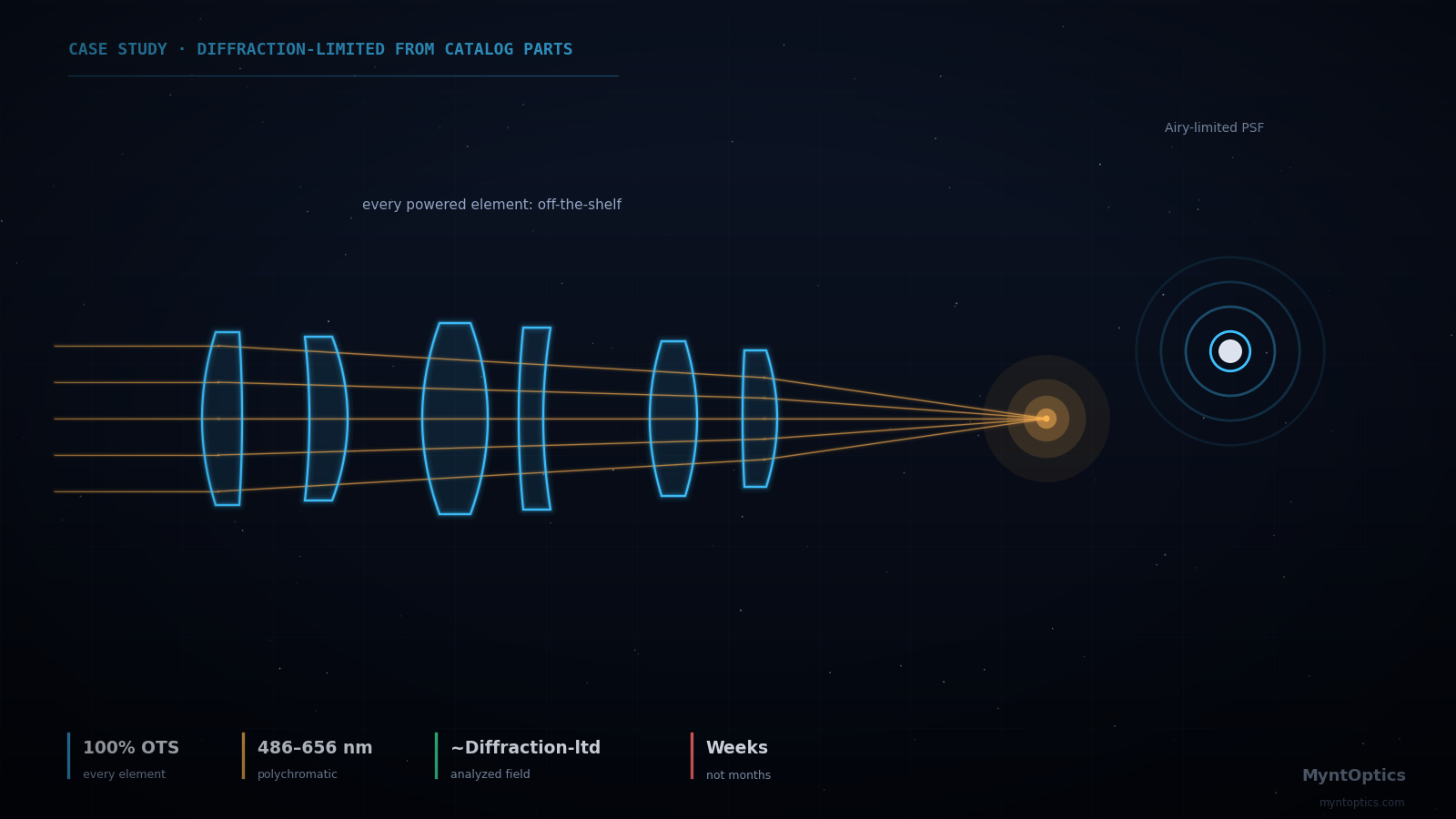
Every powered element comes from a supplier's shelf — and the polychromatic MTF still tracks the diffraction limit.
Application
Not every imaging problem deserves a custom lens. When an instrument needs to couple an existing objective to a different sensor format, insert a filter or beam-conditioning stage, or re-image through a new mechanical interface, the right answer is often an adaptor optic — a designed lens group that bridges what exists to what is needed. This engagement called for exactly that: a custom imaging adaptor for a precision instrument, on a startup timeline and budget that ruled out custom-fabricated elements.
The Challenge
The catalog-component route is widely attempted and frequently botched. Stacking off-the-shelf achromats by intuition typically delivers a system that works on axis and falls apart across the field — residual aberrations compound, pupils mismatch, and the result disappoints by exactly the margin nobody budgeted for. The challenge is that catalog design is a discrete optimization problem: instead of freely bending surfaces, the designer must navigate a finite menu of available radii, glasses and diameters and still land on a corrected system. It demands more design discipline than custom glass, not less.
The performance bar here was unambiguous: image quality close to the theoretical diffraction limit, polychromatic, across the full field of use — with every powered element coming from a supplier's shelf.
What We Analyzed and Delivered
- Architecture selection: evaluated candidate relay/adaptor configurations against field, aperture and packaging constraints before committing to a layout.
- Discrete optimization over catalog space: systematic search across available catalog elements — radii, glasses, diameters — to find combinations whose aberration contributions cancel rather than compound, including element orientation and air-space tuning as free variables.
- Full-field polychromatic verification: MTF analysis across the visible band (486–656 nm) at multiple field positions, benchmarked directly against the diffraction limit; distortion and chromatic behavior quantified.
- Integration package: mechanical spacing prescription, mount and interface definition, and an assembly-tolerance sanity check so the as-built stack performs like the model.
Achieved Results
| Parameter | Achieved |
|---|---|
| Powered elements | 100% off-the-shelf catalog components |
| Spectral band | 486–656 nm (polychromatic) |
| Image quality | Polychromatic MTF close to the theoretical diffraction limit across the analyzed field |
| Lead time | Weeks (component order + assembly) versus the multi-month cycle of custom fabrication |
| Cost profile | Catalog pricing, no NRE for custom elements, no minimum-quantity exposure |

Why This Matters
Knowing when not to design custom glass is a competence in itself. MyntOptics treats off-the-shelf integration as a rigorous design discipline — the same analysis depth we apply to custom systems, aimed at a discrete component space — which is how a catalog-built adaptor ends up performing within sight of the diffraction limit. For early-stage products, research instruments and pilot builds, this approach routinely saves months of schedule and the cost of tooling that the project may never need.
Need more performance from parts you can order this week? Challenge us with your interface problem — we'll tell you honestly whether catalog optics can carry it.
Have a similar engineering challenge? Talk to our optical engineers — a fixed-scope diagnostic turns uncertainty into a costed plan, typically within weeks.