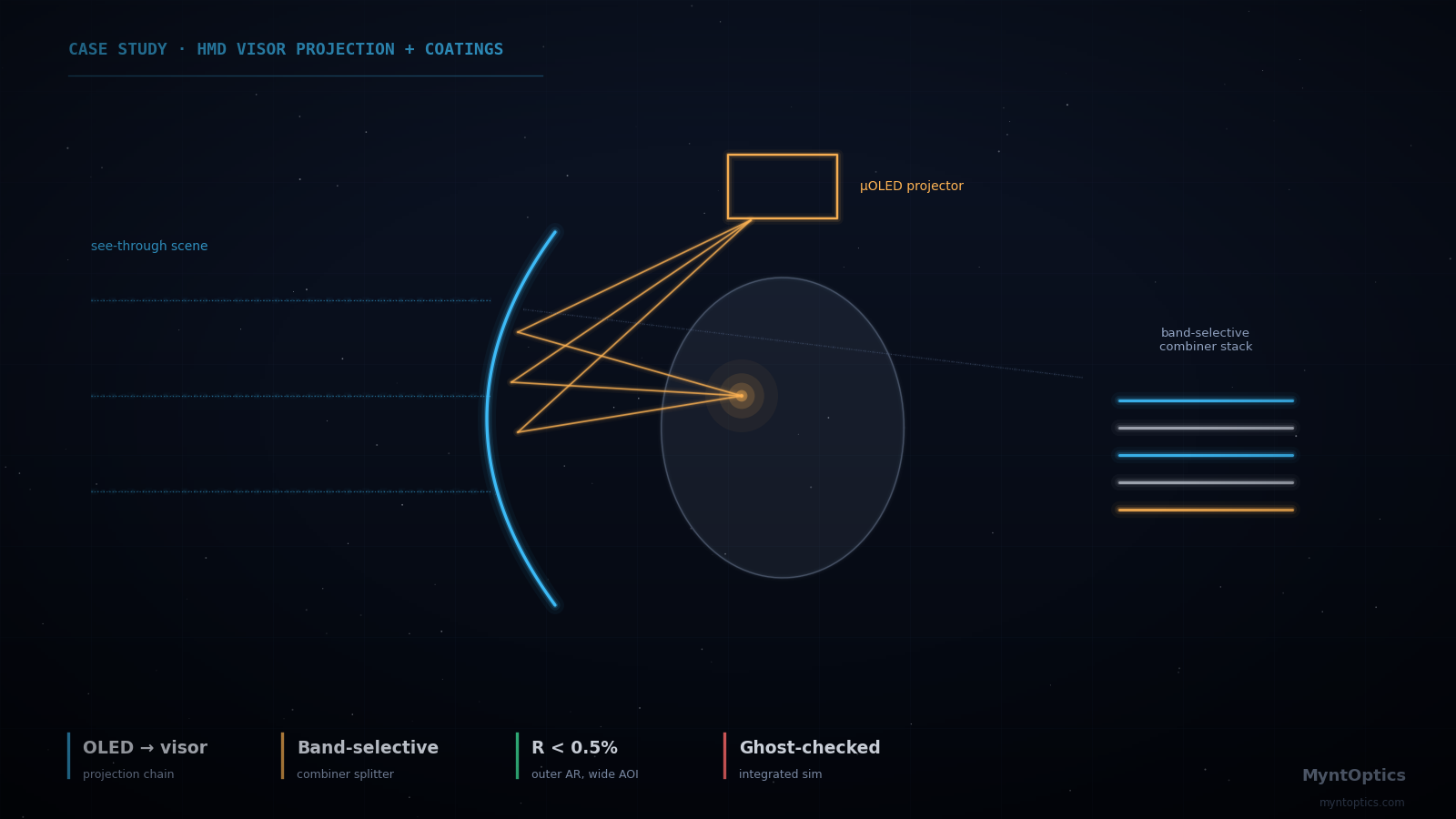
The curved polycarbonate visor doubles as the combiner: a band-selective inner coating folds OLED symbology to the eye while the outer AR coating suppresses ghost reflections.
Application
A visor-projected head-mounted display (HMD) overlays flight- and mission-critical symbology directly on the wearer's view of the world: an OLED microdisplay feeds a compact projection optic, and the curved protective visor itself acts as the combiner that folds that imagery into the eye. It is the most elegant HMD architecture — no extra combiner element in front of the face — and the most demanding, because the combiner is a piece of safety equipment first and an optical surface second.
The Challenge
Three hard problems, tightly coupled:
- The combiner is a 3D polycarbonate visor. It is curved for ballistic and aerodynamic reasons, not optical ones, and it is not rotationally symmetric. Projecting collimated, undistorted symbology off such a surface drives the projection optics toward off-axis and freeform forms that must correct astigmatism, coma and distortion introduced by a shape the optical designer does not control.
- The coatings are half the product. The visor's inner surface needs a multilayer beam-splitter coating that is spectrally selective — strongly reflecting the OLED emission band toward the eye for bright symbology, while transmitting the photopic band so the wearer's view of the world stays clear. The outer surface needs a broadband anti-reflective coating, targeting sub-0.5% reflectance across the visible at the relevant angles of incidence, to suppress the ghost images that double every bright light in the scene.
- It all has to be worn. The optics, display and mounting platform must hold alignment under shock and vibration, within a head-borne weight and envelope budget, with adjustability for the spread of human anthropometry.
What We Analyzed and Delivered
- System architecture definition for the complete projection chain — OLED source, lens/mirror projection assembly, visor combiner, eye — establishing the optical layout, pupil-forming strategy and packaging concept for the head-mounted envelope.
- Combiner coating engineering: specification and design of the band-selective inner-surface beam-splitter matched to the display's emission spectrum, balancing symbology reflectance against see-through photopic transmission; outer-surface AR design for ghost suppression across a wide angular range.
- End-to-end performance simulation plan spanning imaging quality (MTF, distortion mapping, field behavior) and the non-imaging failure modes — ghosting, stray reflections, double imaging through the visor — evaluated on the integrated optics-plus-coatings system rather than in isolation.
- A manufacturability-first design posture: material and architecture choices constrained from day one to readily sourceable glasses, plastics and coating processes, because the program's stated trajectory runs through prototype fabrication, not just a design review.
Achieved Results
| Aspect | Outcome |
|---|---|
| Architecture | Visor-projected HMD chain defined end-to-end: OLED source → projection optics → coated PC visor combiner → eye |
| Inner-surface coating | Band-selective beam-splitter concept matched to display emission; high symbology reflectance with preserved see-through transmission |
| Outer-surface coating | Broadband AR targeting R < 0.5% across the visible over the operational AOI range |
| Correction strategy | Off-axis/freeform projection path compensating the non-rotationally-symmetric visor |
| Verification framework | Integrated imaging + ghost/stray-light simulation protocol covering the full optics-and-coatings system |
Why This Matters
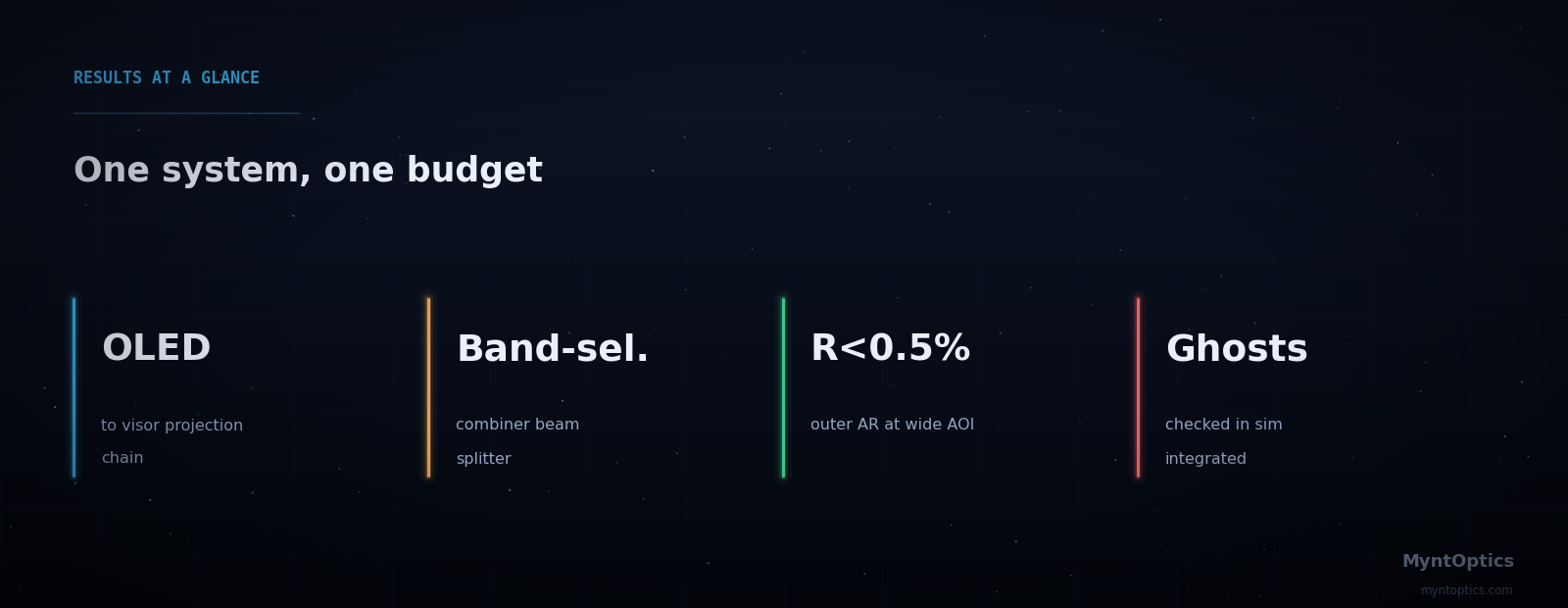
Most teams treat HMD optics and thin-film coatings as separate procurements — and discover at integration that each was optimized against the other. MyntOptics designs the projection optics, the combiner coatings and the mechanical platform as one optical system with one performance budget. That systems posture, combined with disciplined design-for-manufacture, is what moves augmented-vision programs from concept decks to hardware.
Working on an AR, HUD or HMD system? Bring us the whole problem — optics, coatings and packaging together.
Have a similar engineering challenge? Talk to our optical engineers — a fixed-scope diagnostic turns uncertainty into a costed plan, typically within weeks.